If you are searching for boat storage in South Alabama, you have probably noticed something fast: not all storage options are built the same.
Some facilities offer fully enclosed indoor storage. Others offer covered parking-style spaces. Some offer outdoor storage with little more than a designated place to park. Each option comes with tradeoffs. The right choice depends on your boat, your budget, how often you use it, and how much protection you actually need.
If you own a boat in Fairhope, Mobile, Orange Beach, Gulf Shores, or anywhere near the Alabama coast, this decision matters. Heat, humidity, storms, and salt-heavy air can do real damage over time. So before you pick the cheapest option and call it done, it helps to know what you are actually getting.
Why Storage Type Matters in South Alabama
South Alabama is hard on boats. That is just reality.
Strong sun can fade finishes, crack upholstery, and wear down covers. Humidity creates mildew problems. Storms bring rain, debris, and wind. Salt in the air can speed up corrosion on metal parts and trailers, especially in coastal areas like Orange Beach and Gulf Shores.
That means the type of storage you choose affects more than convenience. It affects maintenance costs, condition, and how well your boat holds up over time.
What Is Indoor Boat Storage?
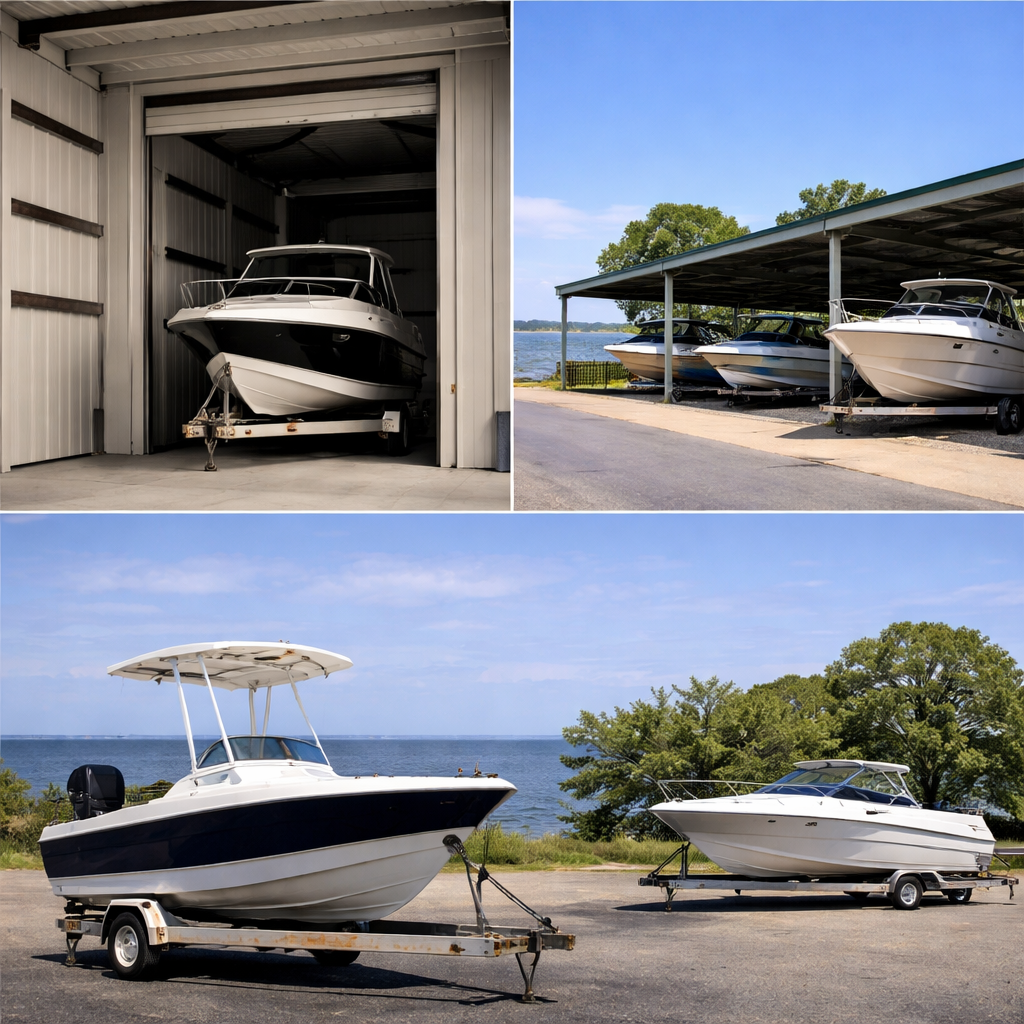
Indoor boat storage usually means your boat is kept inside a fully enclosed unit or building. In many cases, this is the highest-protection option available.
For South Alabama boat owners, indoor or enclosed storage helps protect against:
- direct sunlight
- heavy rain
- wind-blown debris
- excess moisture exposure
- long-term weather wear
If you want to keep your boat in the best condition possible, indoor boat storage in South Alabama is usually the strongest option.
Pros of Indoor Boat Storage
- Best protection from weather
- Helps reduce sun and moisture damage
- Better for long-term storage
- Helps protect upholstery, electronics, and finish
- Often gives owners more peace of mind
Cons of Indoor Boat Storage
- Usually costs more than covered or outdoor options
- Availability may be more limited
- Larger boats may need specific sizing
For many owners, though, the extra protection is worth it. A boat is a major investment. Storing it in a fully enclosed space can help prevent a lot of expensive wear and tear.
What Is Covered Boat Storage?
Covered boat storage gives your boat an overhead roof but does not fully enclose it. Think of it as a middle-ground option.
This setup can help shield your boat from direct sunlight and some rain exposure, but it leaves the sides more open. So while it offers more protection than outdoor storage, it does not offer the same level of defense as indoor storage.
Pros of Covered Boat Storage
- Better protection than outdoor storage
- Helps reduce direct sun exposure
- Often costs less than indoor storage
- Can be a solid choice for short- to medium-term storage
Cons of Covered Boat Storage
- Less protection from wind and humidity
- Still exposed to some moisture and debris
- Not as protective for long-term storage near the coast
Covered storage can make sense if you want a balance between price and protection. But if your main goal is preserving your boat for the long haul, it may not be enough.
What Is Outdoor Boat Storage?
Outdoor boat storage is the most basic option. Your boat is parked in an open space, usually on a lot inside a storage property.
It is often the least expensive choice, but it also leaves your boat the most exposed. In a place like South Alabama, that matters.
Pros of Outdoor Boat Storage
- Usually the lowest-cost option
- Often easier for quick access
- Can work for short-term storage
Cons of Outdoor Boat Storage
- Full exposure to sun, rain, wind, and humidity
- Greater risk of fading, mildew, corrosion, and weather damage
- Covers alone may not be enough for long-term protection
Outdoor storage may work if you use your boat constantly and only need somewhere to park it between trips. But for longer stretches, especially in Alabama’s climate, it is usually the weakest option for protection.
Which Boat Storage Option Is Best?
The honest answer: it depends on what you care about most.
If your top priority is maximum protection, indoor storage wins.
If your goal is a balance between protection and cost, covered storage may work.
If your main concern is lowest monthly price, outdoor storage will usually be the cheapest.
But this is where people mess up: they compare storage options only on price.
That is shortsighted.
A lower monthly rate does not mean much if your boat ends up with faded gel coat, cracked seats, mildew, trailer wear, or higher repair bills later. For many boat owners in Fairhope and throughout Baldwin County, paying more for better protection is the smarter financial move in the long run.
What South Alabama Boat Owners Should Consider
Before choosing between indoor, covered, and outdoor boat storage, ask yourself:
- How often do I use the boat?
- Am I storing it for a few weeks or several months?
- How much do I want to protect it from sun and humidity?
- Is my boat stored near the coast where salt air is a bigger issue?
- Would I rather save a little now or protect the boat better long-term?
If you are storing a boat through peak summer heat, storm season, or for extended periods between trips, enclosed boat storage in South Alabama usually makes the most sense.
Best Boat Storage for Fairhope, Mobile, and Coastal Alabama
For people near Fairhope, Mobile Bay, Orange Beach, and Gulf Shores, weather protection matters more than it might inland. Moisture, storms, and sun exposure are not occasional problems here. They are normal.
That is why many local owners lean toward indoor boat storage or other more protective options when possible. It simply gives the boat a better chance of holding up well over time.
Final Thoughts?
When comparing indoor vs. covered vs. outdoor boat storage in South Alabama, the right choice comes down to value, not just monthly price.
Indoor storage gives the most protection. Covered storage gives moderate protection. Outdoor storage gives the least.
If you want to keep your boat in better condition, reduce long-term wear, and avoid unnecessary damage from Alabama weather, stronger protection is usually the smarter move.
Your boat is too expensive to treat like an afterthought. Store it accordingly.